In our Commencement Communion service this morning at Union Theological Seminary, I bid these ivory towers farewell with these words (loosely exegeted from Ephesians 6:18-24):
“Life is combat.” These are not my words. In fact, I know these words by Walter Wink were far from my mind when I first sat in Room 207 for orientation three years ago. I didn’t think that answering my call into God’s service had anything to do with combat. Sitting in Room 207, like so many of you, I was concerned about poverty, sexism, racism and homophobia. Like you, I came to Union to make our world better.
Life certainly wasn’t combat for me. And, thankfully, Walter Wink didn’t stop with this sentence. He continues, “ours is neither a perfect nor a perfectible world; it is a theater of perpetual conflict which the prize goes to the strong.” If life is the “theatre of perpetual conflict,” then I think we as graduates of Union Theological Seminary, do indeed have a fighting chance.
If our combat is theater, let’s set the stage and put on our costumes. On this end of Broadway, we like to get dressed up. If you don’t believe me, just ask Brian Cave. Whether singing Carmina Burana or swinging from the rafters at the Pub on Mardi Gras, we like to get dressed up.
Three years ago, I remember that I had very carefully chosen my costume for my debut in Room 207. It was the first time I had adorned the armor of God. And even though I carefully planned and selected my attire, I only remember that the shoes for my feet were flip-flops. Flip-flops have probably been my favorite choice for the shoes on my feet in these three years. Whether I was rolling out of bed for an 8 am Preaching and Worship class or dashing to noon chapel in order to earn my perfect attendance award, I was in flip-flops.
However, I don’t think that flip-flops are really a good choice for armor. In fact, I’m not sure that they are a good choice for the theater. During these three years, we have each played with our choice in costumes. Some of us may never have referred to our dressing up as the “wiles of the devil” as in this letter to the Ephesians. And even as we leave here, we might never want to say that.
But, these are wiles that we are very familiar with. These wiles have dominated our conversations in caucus meetings, classroom discussions or even in conversations in the shelter of the Sukkah in the wee hours of the morning after wine night. The wiles of empire. These wiles have gathered us together here. These wiles have inspired us to march down Madison Avenue protesting war under the Social Action banner. These wiles provoked Angela Escueta and I to terrify the incoming second years with a civil disobedience training in preparation for the Republican National Convention. While I clearly provided some leadership for the Social Action Caucus, we were each motivated by these wiles. So, what did you wear?
What did you wear when you first donned the armor of God? Did you read Scripture in chapel in a t-shirt that proclaimed “Value your Vagina. Vote.”? Or one that announced “Christian in Action”? What did you wear when you first struggled against the cosmic powers of this present darkness?
And what will you wear as you leave? What will your armor of truth, righteousness and peace look like?
As I go from here, I will wear this place as my armor. I will adorn the prophetic words of Delores Williams and James Cone. I will wear the loving embrace of Wyn Wright who reminded me again and again of why I continue with all of this. I will get all dolled up in the courage that Janet Walton continues to give me to believe in the power of art in our worship. I will show off the confidence that Barbara Lundblad gave me to preach. I will wrap myself in the Word that Hal Taussig challenged me to reclaim, even if Revelation is still a mystery to me. I will sail off wearing the quiet sarcasm and wisdom of Troy Messenger. I will I wrap myself in the self-care practice of 7th floor of Hastings sharing marathon upon marathon of Law and Order episodes. I will get decked out in the loving community of women who are proud to announce from the pulpit, “Value your Vagina.”
I will wear the breastplate of this community. I will wear the belt of each of you. And I will go out into the “theatre of perpetual conflict” wearing fantastic shoes on my feet, ready to proclaim the gospel of peace because Walter Wink was right. The prize will go to the strong. The prize will go to the strong because each of you will be in every one of my steps.
5.19.2006


5.10.2006
Leaving New York
I am in the process of boxing up the place that I have called home for the past three years. I am leaving New York in a mere two weeks after living here for six years. It's a sad departure, even though I never actually thought that I would live here. But, here I am getting ready to leave this fair city. And I have to admit, I'm a little excited. I'm excited to see grass that I don't have to traverse miles of concrete to discover. I can't begin to explain my excitement.
And yet, it seems that I have to find some way to explain this excitement. I have had two phone interviews already where I have been asked how I feel about not being in New York. It's funny to hear this question. I don't think about myself as a New Yorker. I am. I know I am. But, I don't feel like a New Yorker. Perhaps because I'm so excited to leave.
I am excited to leave behind the weird sense of community in New York. It's a city with wonderful cultural resources and tremendous diversity. But, theater tickets are more expensive than museum entry fees. And we don't really relish in the wonder of our own diversity. We live in compartments where neighbors don't know each other by name or face. We travel underground together but become annoyed when anyone crowds our space. We don't want to touch anyone in this city. We want to live without connections while complaining about our lack of community. We forget to realize the fantastic wealth around us.
I'm ready to leave this behind. I'm ready to engage in real community where I bump into neighbors while grocery shopping or down the street. I don't really know what this will look like. But, I know that I am very ready to leave New York.
And yet, it seems that I have to find some way to explain this excitement. I have had two phone interviews already where I have been asked how I feel about not being in New York. It's funny to hear this question. I don't think about myself as a New Yorker. I am. I know I am. But, I don't feel like a New Yorker. Perhaps because I'm so excited to leave.
I am excited to leave behind the weird sense of community in New York. It's a city with wonderful cultural resources and tremendous diversity. But, theater tickets are more expensive than museum entry fees. And we don't really relish in the wonder of our own diversity. We live in compartments where neighbors don't know each other by name or face. We travel underground together but become annoyed when anyone crowds our space. We don't want to touch anyone in this city. We want to live without connections while complaining about our lack of community. We forget to realize the fantastic wealth around us.
I'm ready to leave this behind. I'm ready to engage in real community where I bump into neighbors while grocery shopping or down the street. I don't really know what this will look like. But, I know that I am very ready to leave New York.
4.27.2006
Humbled
In the fourteenth chapter of the Gospel of Luke, Jesus preaches about a banquet. In the middle of this teaching, he advises "For all who exalt themselves will be humbled, and those who humble themselves will be exalted" (v. 11, NRSV). Exaltation is far from what I am feeling as I approach graduation, which is probably good because who really needs to be that arrogant? But, recently, in prayer and thought, I find myself ever humble. I'm surprised by the blessings that lie ahead of me. I'm warmed by the people in my midst. I'm awed by the hope that I hold for this journey toward the unknown.
I graduate really, really soon. It means that I leave New York. It means that I leave the sheltered world of academia. It means that I leave everything that is familiar to me -- everything that has been home for over 5 years. I'm filled with all kinds of exciting energy. I don't know what will happen. I don't know what will come. It seems that there is endless possibility as all of my dreams seem suddenly real. I'm so very humbled by this experience of simply saying goodbye. I'm humbled by the power of saying "yes" to God's call. I'm humbled as just now I schedule a phone interview for a church that would be so amazing to share with in ministry. Wow. I'm not sure I feel exalted in the slightest. But, wow. Wow!
I graduate really, really soon. It means that I leave New York. It means that I leave the sheltered world of academia. It means that I leave everything that is familiar to me -- everything that has been home for over 5 years. I'm filled with all kinds of exciting energy. I don't know what will happen. I don't know what will come. It seems that there is endless possibility as all of my dreams seem suddenly real. I'm so very humbled by this experience of simply saying goodbye. I'm humbled by the power of saying "yes" to God's call. I'm humbled as just now I schedule a phone interview for a church that would be so amazing to share with in ministry. Wow. I'm not sure I feel exalted in the slightest. But, wow. Wow!
4.07.2006
What Would Judas Do?
Holy Week begins on Sunday. The dramatic narrative will all begin as we journey together into Jerusalem. We will celebrate Jesus' triumphant arrival into the city to begin the story that offers us hope as Christians. But, with all of this joy and celebration, there are a lot of dark moments in this story after this arrival. There is a dark evening meal shared by a small group of friends in an upper room. There is betrayal. There is a brutal death. There is judgment and sentencing that still manages to encourage Christians to point fingers at the guilty.
Maybe it's because we don't know how to talk about betrayal. Maybe we don't know how to understand that gap between humanity and the divine. So we point fingers and we blame others. Maybe we are trying to make sense out of something impossible. We blame the Jews. We blame Judas. And sometimes, we even blame ourselves. Perhaps we even blame ourselves as Judas. Perhaps we are able to relate to this betrayal in some way.
But, do we really know Judas story? The story in the gospels is confusing. John tells us that Judas is to blame. He is the one that sets the whole story in motion. Scholars have argued about Judas' choice, if he indeed had one. Scholars will continue to argue about whether or not the story needed to end this way. How else do we get to Easter? How else can we grasp the amazing connection that we have to God? And yet, our Jewish brothers and sisters knew this all along. But, I digress.
Maybe we will get the story straight. It appears on the New York Times coverpage today: the Gospel of Judas has been discovered. Apparently, the text reveals the confusing nature of this betrayal. Jesus Christ Superstar hinted to the fact that Judas shared an intimate connection to Jesus. Perhaps if we read our canonical gospels, we might find this same connection. Perhaps we might read John differently. Perhaps the Beloved Disciple and Judas are not polar opposites. Perhaps they each shared the intimate connection of lying on Jesus' chest. Maybe it happened for Judas at another meal. Maybe we want to make a fluid story. Or worse, perhaps we are too eager to paint a clear picture of evil. Satan enters Judas at this meal in John. Evil becomes manifest and we develop a bad guy. Sadly, we have just accepted Judas as a bad guy.
Maybe today that will change. The article in the New York Times suggests, "The Gospel of Judas portrays Judas Iscariot not as a betrayer of Jesus, but as his most favored disciple and willing collaborator." Perhaps we will learn to ask what would Judas do. Maybe this will make us better Christians. Maybe we will no longer accept evil. Maybe we will challenge our own judgments.
Maybe it's because we don't know how to talk about betrayal. Maybe we don't know how to understand that gap between humanity and the divine. So we point fingers and we blame others. Maybe we are trying to make sense out of something impossible. We blame the Jews. We blame Judas. And sometimes, we even blame ourselves. Perhaps we even blame ourselves as Judas. Perhaps we are able to relate to this betrayal in some way.
But, do we really know Judas story? The story in the gospels is confusing. John tells us that Judas is to blame. He is the one that sets the whole story in motion. Scholars have argued about Judas' choice, if he indeed had one. Scholars will continue to argue about whether or not the story needed to end this way. How else do we get to Easter? How else can we grasp the amazing connection that we have to God? And yet, our Jewish brothers and sisters knew this all along. But, I digress.
Maybe we will get the story straight. It appears on the New York Times coverpage today: the Gospel of Judas has been discovered. Apparently, the text reveals the confusing nature of this betrayal. Jesus Christ Superstar hinted to the fact that Judas shared an intimate connection to Jesus. Perhaps if we read our canonical gospels, we might find this same connection. Perhaps we might read John differently. Perhaps the Beloved Disciple and Judas are not polar opposites. Perhaps they each shared the intimate connection of lying on Jesus' chest. Maybe it happened for Judas at another meal. Maybe we want to make a fluid story. Or worse, perhaps we are too eager to paint a clear picture of evil. Satan enters Judas at this meal in John. Evil becomes manifest and we develop a bad guy. Sadly, we have just accepted Judas as a bad guy.
Maybe today that will change. The article in the New York Times suggests, "The Gospel of Judas portrays Judas Iscariot not as a betrayer of Jesus, but as his most favored disciple and willing collaborator." Perhaps we will learn to ask what would Judas do. Maybe this will make us better Christians. Maybe we will no longer accept evil. Maybe we will challenge our own judgments.
3.28.2006
A Space to Weep
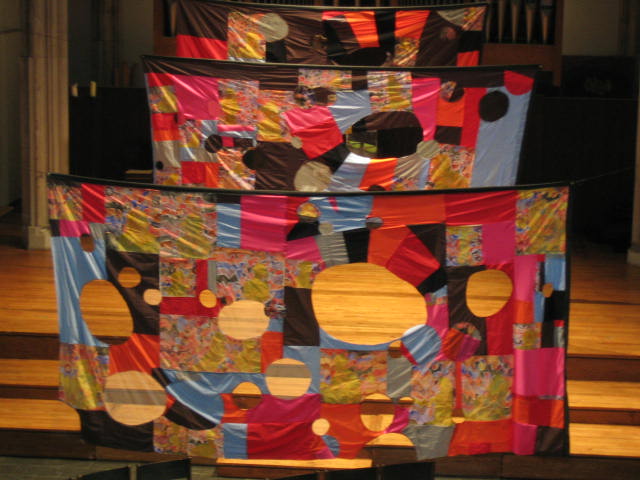


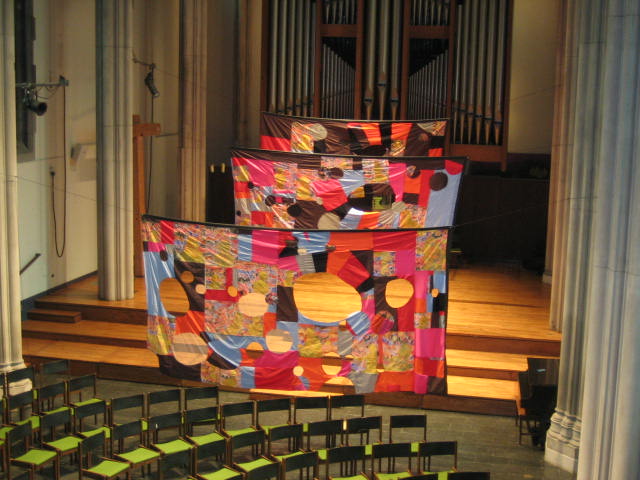
These are images from my thesis which is referred to in previous blogs. Last week, on March 22, I performed a ritual around this installation where I invited friends and family to honor our grief. I reflected upon my own story with the death of my mother and mingled this story with Mary's story in chapter 20 of John's Gospel. I asked the congregation to paint and we concluded in communion. But, early in the service, I spoke these words:
Why are you weeping? Our Savior asks us why we might weep. But, we know that something has changed. Our world has turned upside down. And in all of the uncertainty of what might be, there is a hole. Just a hole. A big, vacant hole. Nineteen years ago, I was the one gazing into this vacant hole. My mother had spent most of my childhood wrestling for her life at the gripping hands of cancer. We didn’t really know that much about cancer then. And it was certainly not something that you shared with your seven-year old daughter. But, soon, something changed. And she was gone.
Maybe it didn’t need to be explained. Maybe there are no words to tell a child that her mother has died. Maybe there are no words to really tell this story.
But, I still remember. I remember standing in the bathroom when my mother lifted her shirt to show me. She has just had a mastectomy, a word I wouldn’t know for a long time. But, I remember the jagged wound that lined where her breast once was.
I weep with Mary. She was left to gaze into this big, vacant hole. And she wept. It is only a moment. There is only a moment for sadness. There is only a moment to mourn. And, then it is over. Three verses later, there is a new beginning. This sacred story that offers us such hope and wonder tells us that he came back.
Why are you weeping? It wasn’t a kind question. We’re supposed to let go. We’re not supposed to cling. But, we can’t help but notice the hole. Why are you weeping? Three days after my mother died, one of my classmates stopped me in the hall at school. She asked if it was true. She had heard the rumors. She wanted to know if my mother had really died of breast cancer. I nodded. Oh, she said. My aunt lived through it.
Why are you weeping? She only had a moment. But, it didn’t happen like that for me. That’s not my story. My mother never came back. There is just a hole. Just a big, vacant hole. My mother died when I was seven. I used to introduce myself with these words. Hi. My mother died when I was seven. And I’m still weeping. There is still a hole. It hasn’t gone away. I’m not quite certain what to do about it. It was only recently that I decided that I could paint it. I’m not sure if it articulates my grief. I’m not sure if it’s really about Mary’s grief. I’m not sure if it’s just scraps of fabric sewn together to try to piece together the holes.
I’m not sure if it’s a creation for all of us. Mary wasn’t alone in her grief. And even if she was alone at the tomb, Mary would have shared this hole in her heart with friends and loved ones. Maybe I’m waiting for you to fill in the holes. Maybe you are waiting for me to caress your holes. It might not be a moment. It might not answer all of our questions. It certainly might not heal us. But, it might give us a space for the holes. It might just give us a space to weep. Just to weep….
The Church and Homelessness
A poor people's movement in Philly once preached, "How can you worship a homeless man on Sunday and step over one on Monday?" I think it's true. I see it every day. Hell, I do it. I don't know how to deal with the people asking for money in the subway. I don't want to ever assume what the money is for and I rarely offer anything from my own pocket. Instead, I bow my head and I pray. If s/he has been bold enough to offer a name, I lift his/her name to God. I ask them to be safe and warm. I bow my head and avoid making eye contact.
Tonight, I was frustrated by this same hypocrasy at the church that I serve. The discussion of homelessness has been a hot topic during the years of construction. There is a scaffolding around the church that has opened the church to a new level of intimacy with the homeless community. And this is a false intimacy. The homeless are not wanted. It's not welcoming. It's scary. It's intimidating. These are valid emotions. I don't want to deny these emotions. But, Jesus asked us to love our neighbor. Tonight, our neighbors are huddled in cardboard boxes upon our steps. Tonight, our neighbors might not have had enough to eat because the shelter system will not allow their level of intoxication. Tonight, a child of God feels lonely. Who will love them?
I attended a church meeting tonight where there were moronic statments made about the homeless situation. I'm amazed that 20 years in the pastorate in New York can allow for anyone to be so blind. I'm amazed when we let our human fears overcome what we know about God. Sure, I struggle with the drug abuse. I think it's hard to deal with alcoholism. But, that's not everyone's story. Indeed, there is mental illness. But, there is another side.
And that is how we react. The city has a horrible shelter system. These are not just stories. These are real situations where people -- God's people -- have been made to feel unsafe. And like it or not, these same attitudes and fears are held toward the shelters in churches. We may worship a homeless man, but we really don't welcome him in on Sunday. We don't want him on our steps. We want to pretend that he is not there. We want someone else to deal with it. We want easy answers, and there are none to be found. Sometimes, we need to accept that God's world is bigger than us and all that we can do is pray for change. This is God's prayer as much as it is our own.
Tonight, I was frustrated by this same hypocrasy at the church that I serve. The discussion of homelessness has been a hot topic during the years of construction. There is a scaffolding around the church that has opened the church to a new level of intimacy with the homeless community. And this is a false intimacy. The homeless are not wanted. It's not welcoming. It's scary. It's intimidating. These are valid emotions. I don't want to deny these emotions. But, Jesus asked us to love our neighbor. Tonight, our neighbors are huddled in cardboard boxes upon our steps. Tonight, our neighbors might not have had enough to eat because the shelter system will not allow their level of intoxication. Tonight, a child of God feels lonely. Who will love them?
I attended a church meeting tonight where there were moronic statments made about the homeless situation. I'm amazed that 20 years in the pastorate in New York can allow for anyone to be so blind. I'm amazed when we let our human fears overcome what we know about God. Sure, I struggle with the drug abuse. I think it's hard to deal with alcoholism. But, that's not everyone's story. Indeed, there is mental illness. But, there is another side.
And that is how we react. The city has a horrible shelter system. These are not just stories. These are real situations where people -- God's people -- have been made to feel unsafe. And like it or not, these same attitudes and fears are held toward the shelters in churches. We may worship a homeless man, but we really don't welcome him in on Sunday. We don't want him on our steps. We want to pretend that he is not there. We want someone else to deal with it. We want easy answers, and there are none to be found. Sometimes, we need to accept that God's world is bigger than us and all that we can do is pray for change. This is God's prayer as much as it is our own.
3.17.2006
Traditional Ministry
Today, the New York Times reported that fewer and fewer seminarians are going into traditional ministry. First, I want to comment on traditional ministry. For most people this is really narrow. For most denominations, it's still a plight for a student to advocate for a call into "alternative" ministry. Ministry happens in all places. There is not one of my peers in seminary that is not in ministry. Indeed, not all of them are currently in a church or have any interest in being in the church. But, this begs us to look at what we mean by traditional ministry.
Tonight, I met a young man in a bar. A young Irish Catholic man. He is not alone on his assumptions about seminarians (though this word was new to him which is a deeper problem that I'm not going to touch). But, to him, ministry is reserved for priests. Even though America was founded by Protestants seeking religious freedom, we are a nation that believes that every religious leader abides by the laws of chastity and poverty. That's just not the case. Joel Osteen and Jim Forbes are only two examples of wealth. And let's not even get started on chastity. But, we think priests. Why? I have no idea. It makes little sense to me. But, I'm a young woman and I'm going into ministry. As it turns out, I'm seeking a call into traditional ministry. I want to be in the church. I believe in the power of the church.
Think back to Katrina. Think of the number of people that responded to this tragedy. Or think further back. Think about the tsunami. There were countless checks that were written. Thousands of hundreds of millions of dollars, which is nice. But, who was on the ground? Who were the people that actually went when they first learned about the disaster? People of faith. Not always people that wear a collar (and again, that's not limited to the Catholics). There are so many lay people that believe it is their call answer the cries of crisis. This, dear friends of the New York Times, is ministry. Ministry is not one thing. Ministry is not preaching or teaching. It can include these things. But, it is not limited to these things. If ministry was to be defined as any one thing, ministry should be understood as being with the other. When you sit down and share with someone's hardship -- a breakup, a death, a tragedy -- then you are in ministry. Motivation doesn't matter, though I beg for an open heart. It's the desire to sit there and listen. It's the love within. This is ministry. Perhaps it's not traditional, but this is what ministry always is.
Now, the New York Times seems to express some shock and dismay that seminarians could do other things besides work in the church. It's as if our fear of religion (Islam, Christianity, you name it) has eroded our intelligence. People of faith can actually be useful? They can be productive citizens? I regret that this is a little insulting. And yet, I wonder if the question shouldn't be turned toward our fear of religious fanatics but to the Church itself. If the Church cannot learn to really and truly love, then why would seminarians accept a call to "traditional" ministry?
You don't believe me? Think of the number of times that we use the name of God to condemn others. My Christian sisters and brothers, I don't care if you are conservative or liberal. You use God in this way. And if the Church can't stop condemning, then what seminarian is going to spend three years learning about the love of God only to preach the opposite? Oh, hell no.
Tonight, I met a young man in a bar. A young Irish Catholic man. He is not alone on his assumptions about seminarians (though this word was new to him which is a deeper problem that I'm not going to touch). But, to him, ministry is reserved for priests. Even though America was founded by Protestants seeking religious freedom, we are a nation that believes that every religious leader abides by the laws of chastity and poverty. That's just not the case. Joel Osteen and Jim Forbes are only two examples of wealth. And let's not even get started on chastity. But, we think priests. Why? I have no idea. It makes little sense to me. But, I'm a young woman and I'm going into ministry. As it turns out, I'm seeking a call into traditional ministry. I want to be in the church. I believe in the power of the church.
Think back to Katrina. Think of the number of people that responded to this tragedy. Or think further back. Think about the tsunami. There were countless checks that were written. Thousands of hundreds of millions of dollars, which is nice. But, who was on the ground? Who were the people that actually went when they first learned about the disaster? People of faith. Not always people that wear a collar (and again, that's not limited to the Catholics). There are so many lay people that believe it is their call answer the cries of crisis. This, dear friends of the New York Times, is ministry. Ministry is not one thing. Ministry is not preaching or teaching. It can include these things. But, it is not limited to these things. If ministry was to be defined as any one thing, ministry should be understood as being with the other. When you sit down and share with someone's hardship -- a breakup, a death, a tragedy -- then you are in ministry. Motivation doesn't matter, though I beg for an open heart. It's the desire to sit there and listen. It's the love within. This is ministry. Perhaps it's not traditional, but this is what ministry always is.
Now, the New York Times seems to express some shock and dismay that seminarians could do other things besides work in the church. It's as if our fear of religion (Islam, Christianity, you name it) has eroded our intelligence. People of faith can actually be useful? They can be productive citizens? I regret that this is a little insulting. And yet, I wonder if the question shouldn't be turned toward our fear of religious fanatics but to the Church itself. If the Church cannot learn to really and truly love, then why would seminarians accept a call to "traditional" ministry?
You don't believe me? Think of the number of times that we use the name of God to condemn others. My Christian sisters and brothers, I don't care if you are conservative or liberal. You use God in this way. And if the Church can't stop condemning, then what seminarian is going to spend three years learning about the love of God only to preach the opposite? Oh, hell no.
Subscribe to:
Posts (Atom)


